For this material & slab knowledge guide, the useful answer lives in the shop floor details: slab photos, measurements, install constraints, and whether the team can trust the number before anyone starts fabricating stone.
Last October I watched a homeowner in a Dallas stone yard pick up her phone, pull up a Pinterest board of Calacatta marble kitchens, and ask the salesperson, “Can I get this for my island? We cook every night.” The salesperson, to his credit, didn’t just say yes. He walked her to a display slab, poured a puddle of lemon juice on a scrap piece, and waited sixty seconds. They both watched the acid etch appear. She ended up choosing a Calacatta-look quartzite at twice the price and, from everything I’ve heard since, has zero regrets. That sixty-second demonstration saved both parties a miserable callback six months later.
That interaction is what slab material knowledge actually looks like in practice. Not a spreadsheet. Not a product brochure. The ability to match a customer’s real life to the right stone, backed by enough technical fluency to explain why.
For homeowners, the takeaway is blunt: two shops quoting you the same slab at the same price can deliver wildly different outcomes, and the difference is almost always operational knowledge, not markup.
What You’re Actually Choosing Between
Countertop materials in 2026 break into a few major buckets, and the properties that matter most are not the ones the showroom tends to emphasize.
Natural stone (granite, marble, quartzite, soapstone, travertine) comes out of the ground. Each slab is unique. That uniqueness is the appeal, and also the headache: vein direction, color variation lot to lot, and porosity all vary. Granite sits at 6 to 6.5 on the Mohs hardness scale. Quartzite is harder, 7 to 7.5 Mohs, which is why it handles kitchen abuse better than most people expect. Marble, at 3 to 5 Mohs, is genuinely soft. Beautiful, but soft. If you use your kitchen hard, marble will show it.
Porosity across common granite imports ranges from 0.4 to 1.5 percent by volume. That’s the number that determines how often you need to seal: annually for some granites, every two to three years for tighter stones. Marble and travertine are more porous still.
Engineered quartz (Cambria, Silestone, Caesarstone, MSI Q, Cosentino brands) is roughly 93 percent crushed quartz bound with polymer resin. No sealing required, very consistent color batch to batch, and excellent stain resistance. The catch is heat. Resin damage starts at roughly 300 degrees Fahrenheit. Set a hot pan directly on engineered quartz and you can scorch the resin in a way that no repair fully fixes. Trivets aren’t optional.
Porcelain slabs are the fastest-growing category. Higher heat tolerance, UV stable for outdoor use. But fabrication is more demanding (thinner slabs, more breakage risk during cutting), and not every shop has the tooling or experience to install porcelain well.
Standard slab dimensions in 2026 run roughly 56 by 120 inches in 2cm or 3cm thickness across most major brands and imports. Marble for residential kitchens almost always goes 3cm to avoid flex-related cracking at span points. This is a detail worth asking about. A shop that offers 2cm marble for an unsupported island span is either planning to substrate it or cutting a corner.
Roughly 78 percent of natural stone supply comes from four countries: Brazil, India, Turkey, and Italy.
What a Good Shop Knows (and a Mediocre One Doesn’t)
The boring truth is that most countertop disputes aren’t about defective stone. They’re about mismatched expectations. A customer who picked a high-movement quartzite without understanding that vein matching across an L-shaped kitchen requires careful layout planning. A customer who chose a soft marble for a household with three kids and a dog. A customer who assumed “quartz” and “quartzite” were the same thing. (They are not even close.)
Shops that build a clean internal reference covering material categories, properties, dimensional standards, porosity, heat tolerance, and price tiers see measurable results. Based on trade case studies of mid-sized residential fabrication shops:
- Sales-floor disputes drop by up to 40 percent.
- Showroom-to-quote conversion improves by up to 14 percent within 12 months.
- Material-related callbacks decrease significantly when expectations are set during the sales conversation, not discovered after install.
This is why the question “What’s your callback rate?” tells you more about a shop than the question “What brands do you carry?”
Installed Cost in 2026, Roughly
Pricing moves regionally and seasonally, but ballpark installed costs per square foot in 2026 look like this:
- Granite: $38 to $115
- Engineered quartz: $55 to $130
- Quartzite: $80 to $180
- Marble: $60 to $200
The spread within each category is enormous. A basic Santa Cecilia granite and an exotic Patagonia granite are both “granite” but live in completely different price worlds. Same with marble: Carrara and Calacatta Gold are not in the same zip code on price, though they come from quarries a few miles apart in Italy.
The best value for most heavy-use residential kitchens in 2026, in my opinion, is mid-range quartzite. It’s hard, it’s heat-tolerant, it’s genuinely natural stone with real depth and movement, and it doesn’t carry the resin-damage risk of engineered quartz. The installed price is higher, but the 10-year cost of ownership (factoring in sealing, potential repairs, and replacement probability) tends to work out well.
How Homeowners Can Use This
When you’re evaluating countertop shops, stop comparing only slab prices and start comparing operational signals. Here’s a short checklist:
Ask about yield and callback rate. A shop that tracks these numbers is running a disciplined operation. A shop that looks at you blankly is winging it.
Ask what software they use for quoting and scheduling. This sounds like an odd question for a homeowner to ask. It isn’t. Shops running dedicated fabrication software (Moraware, Actionflow, Systemize, etc.) tend to deliver more consistent timelines and fewer surprises.
Ask how they handle templating. Digital laser templating versus manual templating is a real quality differentiator. Digital templating eliminates most fit issues at install.
Ask about the specific slab. Will you see the actual slab before fabrication? Can you approve the layout? At what point in the process does the shop cut, and can changes be made after templating? These questions separate showrooms that sell pictures from shops that sell finished kitchens.
Owners building a real bench of operational reference material tend to keep this material & slab knowledge guide bookmarked alongside their working playbooks. Homeowners can use that same reference as a starting point for understanding what the shop should already know.
The Production Floor Reality Most Homeowners Never See
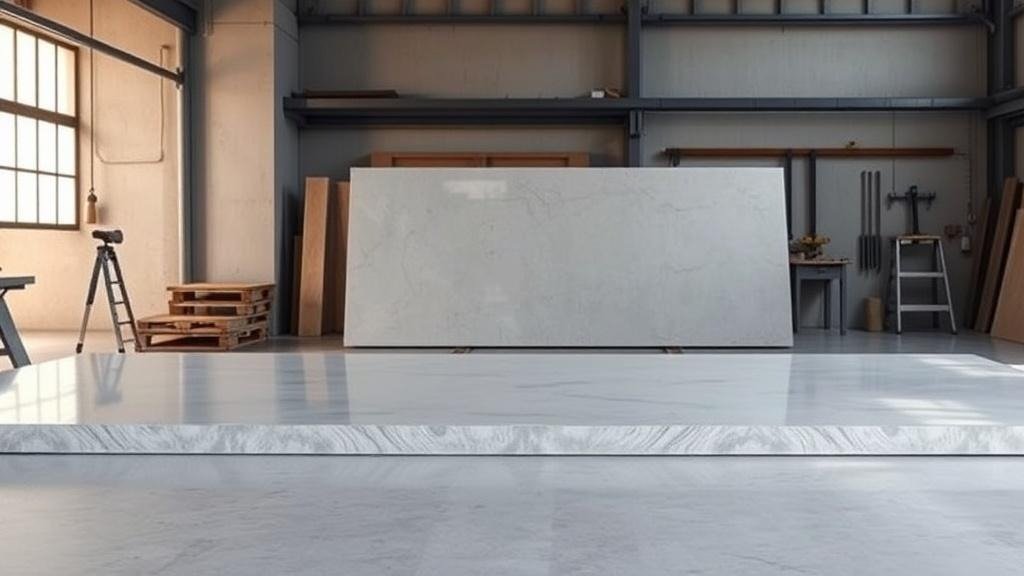
A 3cm granite slab at 56 by 120 inches commonly weighs 600 to 900 pounds. Moving it requires vacuum lifts, forklifts, and trained handlers. This is not a woodworking shop. It’s closer to a small industrial operation, and the safety standards reflect that.
Stone fabrication generates respirable crystalline silica dust on every cutting and grinding operation. OSHA 29 CFR 1926.1153 sets the permissible exposure limit at 50 micrograms per cubic meter as an 8-hour time-weighted average. Shops that take this seriously (wet cutting, proper ventilation, dust monitoring) tend to take everything else seriously too. It’s a reasonable proxy for overall operational discipline, even if you never set foot on the production floor.
When to bring in an expert: Shop owners weighing major capital decisions (new CNC equipment, platform purchases, multi-location expansion) benefit from a trade-experienced consultant or peer review before committing. Trade associations like the Natural Stone Institute and the International Surface Fabricators Association offer member resources and peer networks for benchmarking. Homeowners dealing with complex projects (outdoor kitchens, book-matched slabs, waterfall edges on exotic stone) should specifically seek shops with documented experience in that application, not just a willingness to try.
Frequently Asked Questions
Q: Do all stone materials need sealing? A: Most natural stones (granite, marble, quartzite) require periodic sealing, typically annually to every three years depending on porosity. Engineered quartz does not require sealing.
Q: How does porcelain compare to quartz for countertop use? A: Porcelain offers higher heat tolerance and UV stability for outdoor applications, but it is more demanding to fabricate and install due to thinner slab profiles and higher breakage risk during cutting.
Q: How are slab dimensions standardized in 2026? A: Most quartz and granite slabs run roughly 56 by 120 inches in 2cm or 3cm thickness across major brands and importers.
Q: What is the most popular countertop material in 2026? A: Engineered quartz remains the volume leader in residential work. Quartzite and porcelain are the fastest-growing categories.
Q: How is granite priced compared to engineered quartz? A: Granite installed pricing in 2026 ranges roughly $38 to $115 per square foot; engineered quartz commonly runs $55 to $130 installed. The overlap in mid-range pricing is significant, so material properties (not just cost) should drive the decision.
Q: Is quartzite the same as quartz? A: No. Quartzite is a natural metamorphic stone (Mohs 7 to 7.5). Engineered quartz is a manufactured product of crushed quartz and polymer resin. They behave very differently under heat and over time.
Q: How heavy is a standard countertop slab? A: A 3cm slab at standard dimensions (roughly 56 by 120 inches) commonly weighs 600 to 900 pounds, requiring mechanical handling equipment for safe transport and installation.
Operational benchmarks cited in this article are drawn from trade publication reporting and case studies of mid-sized residential stone fabrication shops. Results vary by shop size, market, and operational discipline.